
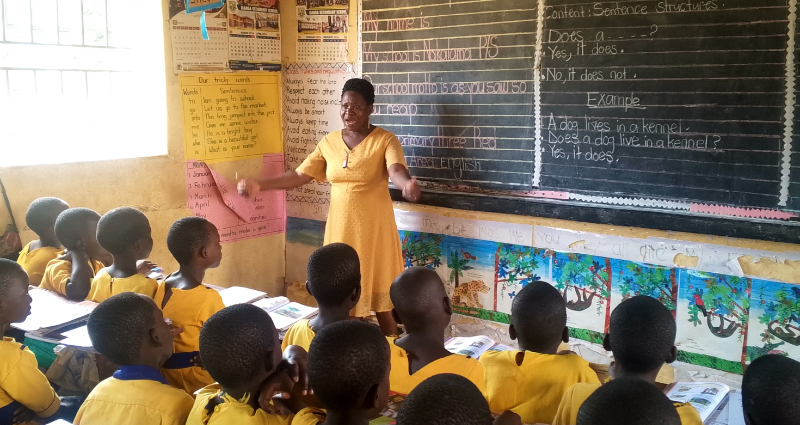
Juliet Kedi, a teacher at Nakalama Primary School in Uganda’s Iganga District, shares how internet connectivity is improving results in her classroom for students with disabilities and in her work as a teacher.
Q: Since your classroom got internet access, what changes have you seen in how your students with disabilities learn or participate?
Since the classroom got internet access, I have seen the children become more involved in the lessons. Before, some children would only look at me making sounds, but they could not always understand clearly. Now, when I use the tablet to show pictures, sounds and actions, they can see what is being taught and take part. For example, when I teach a sound like “s” for snake, the child can look at my mouth, listen to the sound and then point to the picture of the snake on the tablet. This shows me that the child has understood the sound and connected it to the right word or picture. This has helped children with disabilities participate more because they can show understanding through looking, listening, pointing and reacting to the pictures.
Q: What tools or digital resources have helped your students learn better?
The main tools that have helped are the tablets and the internet with applications like Kolibri. Some children can hear but cannot talk, so the tablet helps them answer by pointing at pictures or words instead of speaking. The tablets make it easier for these children to take part in the lesson even when they cannot answer by talking.
Q: What difference has this made to you personally as a teacher and how you feel about your work? Has it affected your confidence, motivation or connection with your students?
This has really encouraged me as a teacher and brought me to another level in my work. I feel more motivated because I can see that the children understand better and enjoy the lessons more. Before, we used cards with small pictures that were not very attractive, but now the tablets show clear and sometimes moving pictures. For example, a child can see how a snake moves, not just hear me explain it. This makes the lesson more interesting for the children, and it also gives me more confidence because I can connect with them better and see their progress more clearly.
Q: Can you describe a moment when one of your students had a breakthrough that felt especially meaningful and how internet access played a role?
A: One meaningful moment happened during a lesson on identifying sounds from pictures. I was teaching sounds from letters like “t” and “m” in an inclusive class, and I was concentrating more on the children who could answer quickly. Issa was seated on the side in his wheelchair, and I did not know that he was also following the lesson. When I asked the children to identify the sound in the word “tree” using the tablet, Issa pulled my dress so that I could pay attention to him. I showed him the tablet, and immediately he pointed to the right answer. That moment showed me that even when a child is quiet, they may be listening and learning, and the tablet gave him a way to show what he had understood.