

Author: Mary Burns
Technology alone cannot fix entrenched gaps in access to digital tools and opportunities, but it remains one of the most powerful tools to reach students with disabilities and others who are left out. When designed and used well, it can improve communication, learning and personalized academic pathways.
For decades, assistive technologies (ATs)—including adapted keyboards and modified mice for motor impairments, screen readers and digital talking books for visual impairments, and Augmentative and Alternative Communication (AAC) tools for those who cannot rely on spoken language—have helped individuals overcome specific functional barriers and participate more fully in learning.
Artificial intelligence is now extending these foundations, but its impact depends on how it is deployed. While the evidence is still emerging, here are five examples of how AI may support children with diverse learning needs.
Neurodivergence
Neurodivergent learners are those whose brains process, learn and behave differently from what is considered “typical” within education. For children with Autism Spectrum Disorder (ASD), for example, chatbots – AI applications designed to simulate human conversation – can offer a low-stakes environment for rehearsing social interactions without fear of judgment. Several controlled studies suggest measurable benefits for communication skill development among ASD learners . Speech-enabled robots can further support social and communicative development, offering socioemotional support that may alleviate anxiety and promote engagement in learning.
Dyslexia
The most common of all neurocognitive disorders, dyslexia affects an estimated 15-20% of the global population and represents 80–90% of those with learning disabilities. Frequently underdiagnosed, dyslexia is lifelong, language-based learning disability that makes reading, writing, spelling and phonological processing difficult. Without targeted support, students with dyslexia struggle in the text-heavy environments of most traditional classrooms.
AI can help these students by converting text into speech, so that they can listen to, rather than read, content. AI-annotated text is also showing promise in improving reading performance for dyslexic students. Platforms such as ReadSmart, which integrate both Augmented Reality (AR) and generative AI technologies, have show positive results in supporting reading comprehension.
Speech Impairments
The human voice has been described as our “acoustic fingerprint”—a unique human identifier. For students who are aphasic, AI-powered voice technologies can create a version of their original voice, enabling them to communicate more naturally through assistive tools. Voice-banking systems can similarly preserve elements of a child’s voice for use with Augmentative and Alternative Communication (AAC) devices as the their needs evolve.
For children with speech disorders, AI can also help clarify or enhance spoken language. Tools like Children’s Reconstructed Speech for Speech Sound Disorders (ChiReSSD) combine machine learning with human speech to generate corrected speech that still sounds like the child. Other tools, like Voiceitt, learn a child’s unique speech patterns translate them into more understandable speech.
Visual Impairments and Deaf Learners
AI-powered voice assistants allow visually impaired students to search digital libraries and access read-aloud content. Other AI applications can translate text and voice into sign language in real time. AI platforms like Deaf AI offer sign language translation across more than 60 languages, while tools like AudioPen can transcribe spoken language into text.
Barriers Limiting Promise
Despite AI’s promise for students with diverse learning needs, two significant longstanding barriers may limit its use. Cost remains foremost: adopting and integrating AI requires investment that wealthier countries can absorb but poorer ones cannot, thus constraining reach. As of 2023, only four countries had formally validated and recommended AI-assisted tools for inclusive access at the governmental level.
Beyond cost, these tools often operate within systems that undermine their potential. Procurement decisions are routinely made without the systemic accessibility planning—integrating design, curriculum and instruction—that effective use requires.
When designed well, AI-supported solutions can make learning genuinely more inclusive and responsive to individual needs, but many tools directed at schools are not designed according to a pedagogically sound approach. Standard software may fall short of Universal Design for Learning principles and large technology companies often favor feature checklists over task-based design, creating unnecessary complexity. Interoperability failures further limit impact, as tools functioning within one ecosystem often fail in another. Finally, and crucially, teachers remain widely undertrained both in assistive technology and AI integration.
Taken together, these challenges underscore the double-edged nature of AI in education: powerful in potential, but uneven in practice. Effectively integrating AI into education requires more than better tools—it demands coordinated action across policy, design, investment and teacher support.
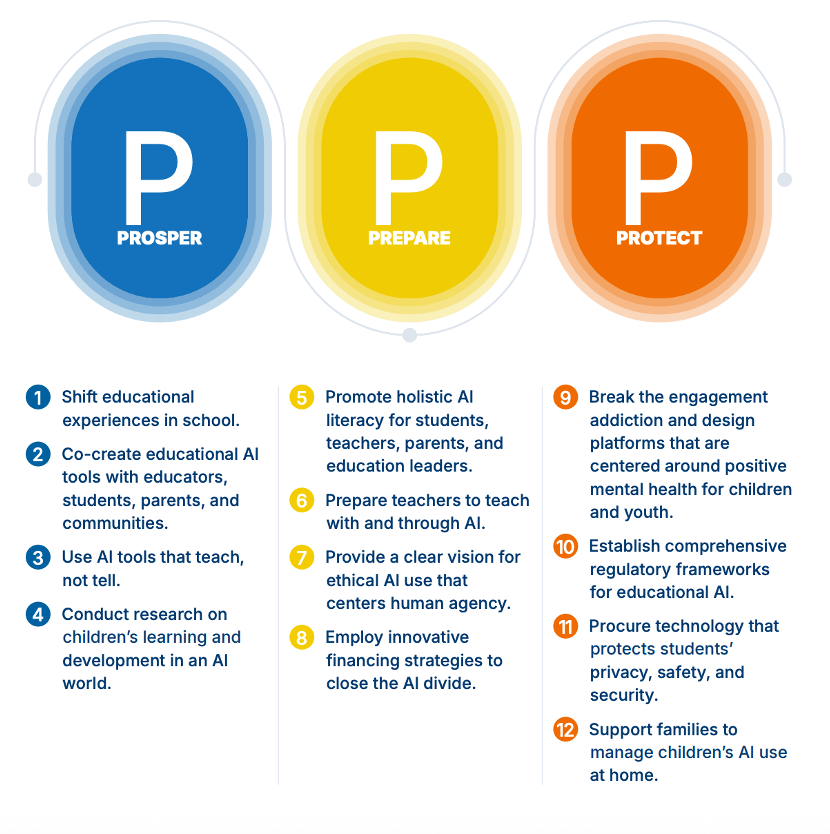
A recent Brookings Institution report, A new direction for students in an AI world: Prosper, prepare, protect, outlines 12 recommendations for multiple stakeholders organized around three foundational pillars. Together, they form a comprehensive framework for the implementation of AI in education for learners with disabilities.
Mary Burns is an internationally recognized expert in technology in education and works across the globe. Her last three publications include: A new direction for students in an AI world: Prosper, prepare, protect; Eyes wide open: What we lose from generative AI in education, and Distance learning for teacher training: Modes, models and methods