Connecting schools begins with knowing where they are. But planning how to connect them also requires a reliable picture of the infrastructure around them and the cost of extending different connectivity technologies.
Obtaining this information is rarely straightforward. Infrastructure data may be held by several organizations, recorded in different formats or unavailable at the level of detail required for modelling. Even when the necessary data exists, the institution coordinating the work may not have the authority to obtain it.
Guatemala’s experience offers a valuable lesson. When the information required for infrastructure modelling is not available through the expected channels, repeating the same request may not produce a different result. It shows how national institutions and Giga technical teams can reframe the problem, identify credible complementary data sources and keep connectivity planning moving while longer-term regulatory improvements are considered.
The country’s data-collection journey was marked by encouraging early progress, an institutional constraint, a methodological breakthrough and one last obstacle. Taken together, these experiences show that successful infrastructure modelling depends not only on technical expertise, but also on persistence, coordination and a willingness to find credible new pathways when the expected ones do not work.
A promising start
In October 2025, Giga, the joint UNICEF-ITU initiative, began laying the groundwork for infrastructure modelling in Guatemala. The aim is to help a government understand the networks available around schools, assess possible ways to connect them and estimate the associated costs.
The country’s Superintendency of Telecommunications (SIT) served as the main counterpart, appointing a local focal point and enabling the first step: organizing the collection of four key infrastructure datasets.
The process moved quickly at first. Communication channels were open, responsibilities were understood and the technical requirements were clear. By early November, the national cell tower database and an initial set of microeconomic data on deployment costs had already been secured. Mobile coverage and fibre networks were expected to follow.
This early progress suggested that data collection would be completed as planned. But the remaining information depended ontelecom operators, and obtaining it proved much more difficult.
An institutional constraint
The country’s regulatory framework had no mechanism to require operators to submit the infrastructure data needed for the modelling. Participation was voluntary, so despite repeated requests and meetings, some operators never provided complete information.
Without reliable data on mobile coverage and fibre networks, the technical team could not map the infrastructure available to connect schools. The gap held up every later stage, from infrastructure mapping to the comparison of connectivity options and costs.
By January 2026, with progress stalled, attention had shifted from how to obtain the data to why the expected information was not being shared.
The emerging challenge was institutional: Guatemala did not lack infrastructure or technical expertise. But reporting and coordination arrangements did not deliver the information that infrastructure planning required, and further technical discussions alone were unlikely to change that.
The team needed a credible alternative that would let the modelling work continue, while recognizing that the underlying regulatory issue would still need attention.
Reframing the problem
The turning point came in February 2026 with a change in perspective.
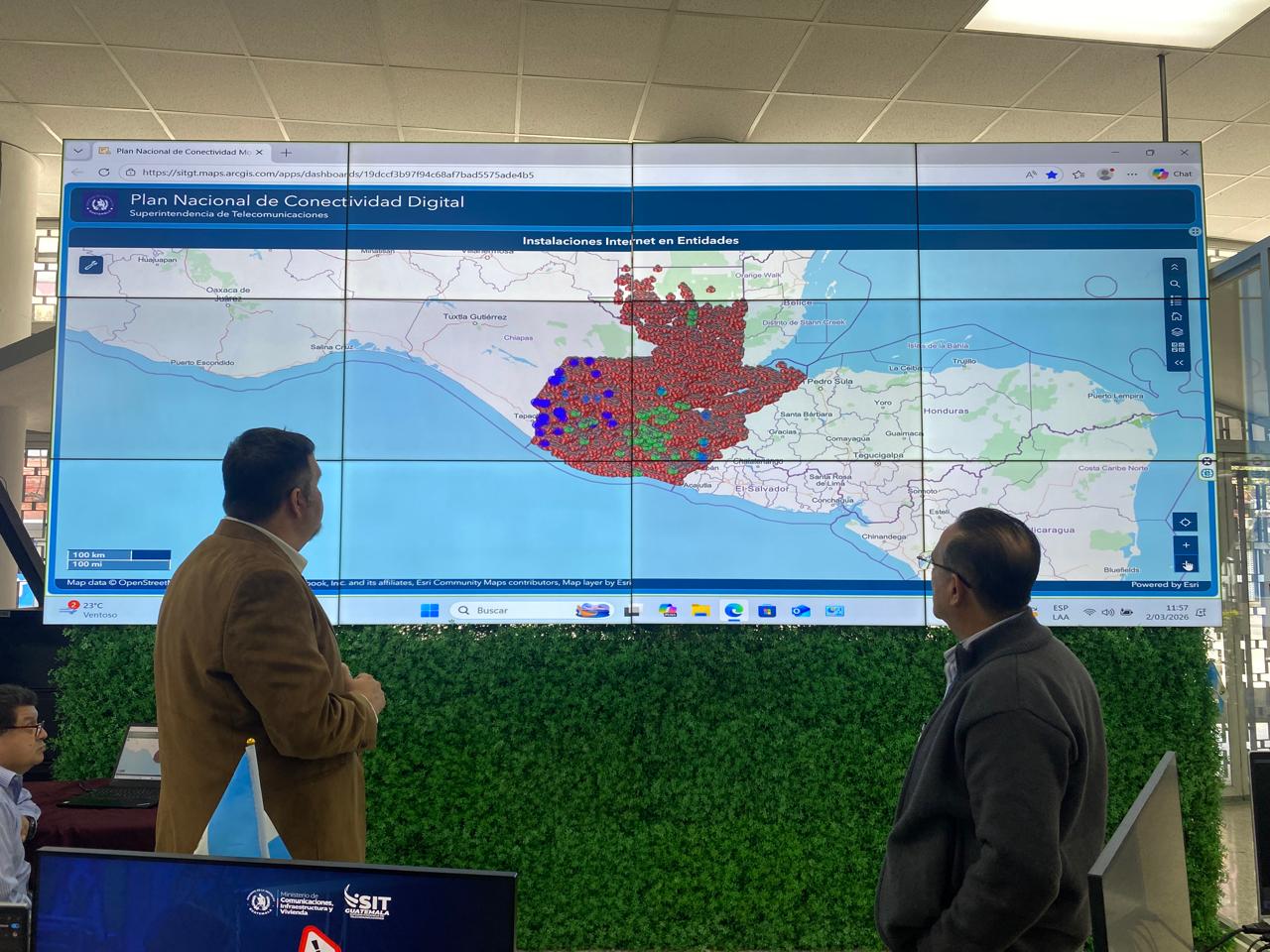
During one of the discussions, SIT proposed looking beyond the organizations that owned and operated the networks. Instead of relying only on the supply side of infrastructure data, the team considered whether information about how networks performed could provide some of the evidence needed for modelling.
This led the team to companies known as network-measurement providers. These companies collect large volumes of crowdsourced information about connectivity performance in different locations across the country.
Network-performance data is not the same as authoritative information provided directly by an operator. It does not explicitlyidentify every physical component of a network. However, it can provide supplementary evidence to help build mobile coverage maps and help estimate possible fibre node locations when operator data is unavailable.
The idea reframed the challenge. The question was no longer only, “How can the team persuade operators to provide the missing information?” It became, “What other credible evidence could answer the modelling question?”
From idea to validated method
Once the alternative approach had been identified, the work moved quickly. SIT convened discussions with a network-performance data provider in Guatemala. The data’s availability alone did not ensure its usefulness. The Giga technical team had to review the data and establish the methodological criteria for its use.
Because crowdsourced measurements depend on where and when observations are collected, Giga’s review addressed their geographic coverage, representativeness, consistency and suitability for the intended modelling purpose.
“SIT proposed an innovative methodology based on crowdsourced data. Once validated by the International Telecommunication Union (ITU), it enabled the telecom infrastructure mapping process to move forward and could serve as a model for other regulators facing similar challenges in accessing this type of data,” said José Luis Antúnez, a SIT consultant.
Innovation without lowering the bar
The experience demonstrates an important principle for other countries: innovation does not mean lowering the standard of evidence. Alternative information should be used only when its relevance, limitations and methodological basis are understood.
Antúnez stressed that alternative data sources should complement rather than replace efforts to strengthen the regulatory framework and improve access to authoritative infrastructure data from operators.
The experience also opened a broader discussion about how network-performance information might be made more accessible in Guatemala. One proposed next step is to establish a transparent reporting mechanism on SIT’s website through which network-performance data providers could publish information on Internet service performance. Such reporting could support incident detection and analysis, as well as assessment of users’ quality of experience.
By this stage, sufficient evidence had been identified to map mobile coverage and estimate fibre node locations, allowing the infrastructure-mapping work to continue. The original bottleneck had not disappeared. Instead, the team found a methodologically grounded route around it.
Keeping long-term reform in view
Alongside the data work, in March 2026, Giga’s Country Coordination Officer for Guatemala, Antonio Braulio Ibacache Reyes, undertook a mission to better understand the institutional landscape and the possibilities for regulatory reform.
Drawing on his work supporting governments with infrastructure data collection, Ibacache observed that approaches in other jurisdictions include reporting obligations, licensing conditions, standardized data requests or cooperative information-sharing arrangements.
“The fact that operators in Guatemala were often reluctant to share infrastructure data did not align with other countries in the region,” Ibacache said. “At the same time, I could see opportunities for dialogue to help unlock solutions.”
Following the mission, collaboration expanded. The ITU regional office was engaged to support discussions, possibilities for coordination between institutions were explored, and SIT continued its outreach to telecom operators.
A final twist: verifying deployment costs
By early April, the mobile coverage and fibre datasets were in place and infrastructure modelling could move forward. Then, with the finish line in sight, another hurdle emerged. The initial microeconomic data on the costs of deploying different connectivity technologies had not been verified by service providers. Without reliable cost inputs, the technical team could not calculate theinvestment scenarios needed to compare connectivity options.
Once again, the team adapted. Instead of treating the dataset as usable simply because it was in hand, the team reconstructed pricing from public procurement records and national tenders. This provided an alternative basis for the cost analysis and allowed the work to continue.
This second adaptation adds a further lesson from Guatemala’s experience: data collection is not complete when a file is received. The information must also be credible, verifiable and suitable for the calculation or decision it is intended to support.
From modelling to informed decisions
With the needed inputs now assembled, Giga is finalizing its analysis of school connectivity scenarios and costs for submission to the Government of Guatemala. The analysis is intended to inform decisions on expanding digital connectivity to the country’s schools.
“The collaboration between the ITU expert groups and the Superintendency of Telecommunications has made it possible to find solutions to each of the challenges that arose during the data collection process for implementing the Giga initiative in Guatemala,” said Herbert Rubio, SIT’s Superintendent of Telecommunications. “At the same time, we continue to make progress on proposals for initiatives that will strengthen our institution’s regulatory role, starting with Giga’s report on infrastructure analysis and modelling.”
The most transferable lesson is simple: when the expected data is unavailable, progress begins by returning to the question the data was meant to answer.
Stay tuned for the next article on Guatemala’s journey to school connectivity, focusing on the effort to modernize its telecom regulatory framework.