By Ivonne Arica Ruiz
As the push for universal internet access accelerates, one of the obstacles that continues to stand in the way of rural connectivity is access to electricity. More than 666 million people are not connected to the electricity grid, of whom 565 million live in Sub-Saharan Africa.
This gap also affects schools in rural or remote areas. A 2025 study found that for one in three African school aged‑ children, the nearest school& has no power at all.
Reshaping possibilities
In the face of this challenge, renewable energy sources such as solar power are becoming the most viable path forward in many parts of the world. According to the World Bank, off-grid solar represents the most cost-effective way to electrify 41% of the global population still lacking access by 2030.
Communities far from the grid have long relied on diesel generators, which come with with high fuel prices, noise, pollution, maintenance ;demands and the risk of vandalism or theft. However, as solar becomes more affordable and scalable, it’s ;reshaping ;what’s ;possible.
“Solar enables us to deploy connectivity infrastructure anywhere, from remote village schools to refugee settlements, while maintaining environmental sustainability and financial viability for communities,” said David Mugerwa, director of technology and engineering at Hello World, a UK-based organization focused on deploying solar-powered school connectivity hubs in Uganda and neighboring countries.
Hello World was one of nine companies selected for the recently concluded inaugural edition of the Giga Accelerator Programme, which sought open-source, scalable digital infrastructure solutions to fast-track Giga’s mission of school connectivity, especially in hard-to-reach areas.
Similar strategies
The products of the Accelerator reflect solar’s growing role in closing the digital divide. Of the nine finalists chosen from over 350 applications, four employ solar-powered, modular systems to fill gaps in places overlooked by larger service providers.
Despite differences, these companies share some common strategies:
- Modular designs deployed one school or community at a time
- Flexible backhaul, adapted to local infrastructure
- Connectivity enhancements through mesh networks or long-range devices
- Value-added services such as device charging or local educational content, creating hybrid community hubs
They also invest in local capacity building—from assembly to maintenance—equipping communities with the skills that help sustain digital access while creating green jobs.
Deployment challenges
Deploying solar solutions isn’t without obstacles. The biggest is high upfront installation costs and the need to size systems for continuity during periods of low sunlight. To address this, these projects include battery storage capable of keeping systems running for up to 72 hours during cloudy periods—a crucial backup to maintain school connectivity.
Below are summaries of the four solar-powered connectivity hubs from the 2025-26 edition of the Giga Accelerator:
Chargebyte
Founded in Nairobi in 2023, Chargebyte builds hybrid grid-solar charging and connectivity stations designed to function through Kenya’s frequent blackouts. “When grid power is available, the station charges its batteries. When there is a power outage, the stored energy and solar panels continue to power the station,” founder Quinter Ochieng explains.
The stations house 24 to 96 rechargeable power banks that users can rent to charge phones, laptops, and other small electronics. Instead of having to walk several kilometres to leave their devices to charge in shops, Chargebyte users can rent a portable power bank for a minimal fee to charge devices at home or on the move.
Energy capacity depends on the size of the power station, smaller stations require 200w panels and larger stations 1.2kW panels.
Beyond power, the stations also serve as connectivity hubs, supporting up to 300 internet users and delivering 10–15 Mbps speeds. As Ochieng notes, “Now with 32 stations, we can connect up to 9600 people per day at the maximum usage rate.”
The Giga pilot focused on identifying schools with connectivity and power gaps, training teachers and local stakeholders, and deploying charging and connectivity stations to support device use and access to the internet. Looking ahead, Chargebyte is planning expansion to Rwanda, Nigeria, and South Africa.
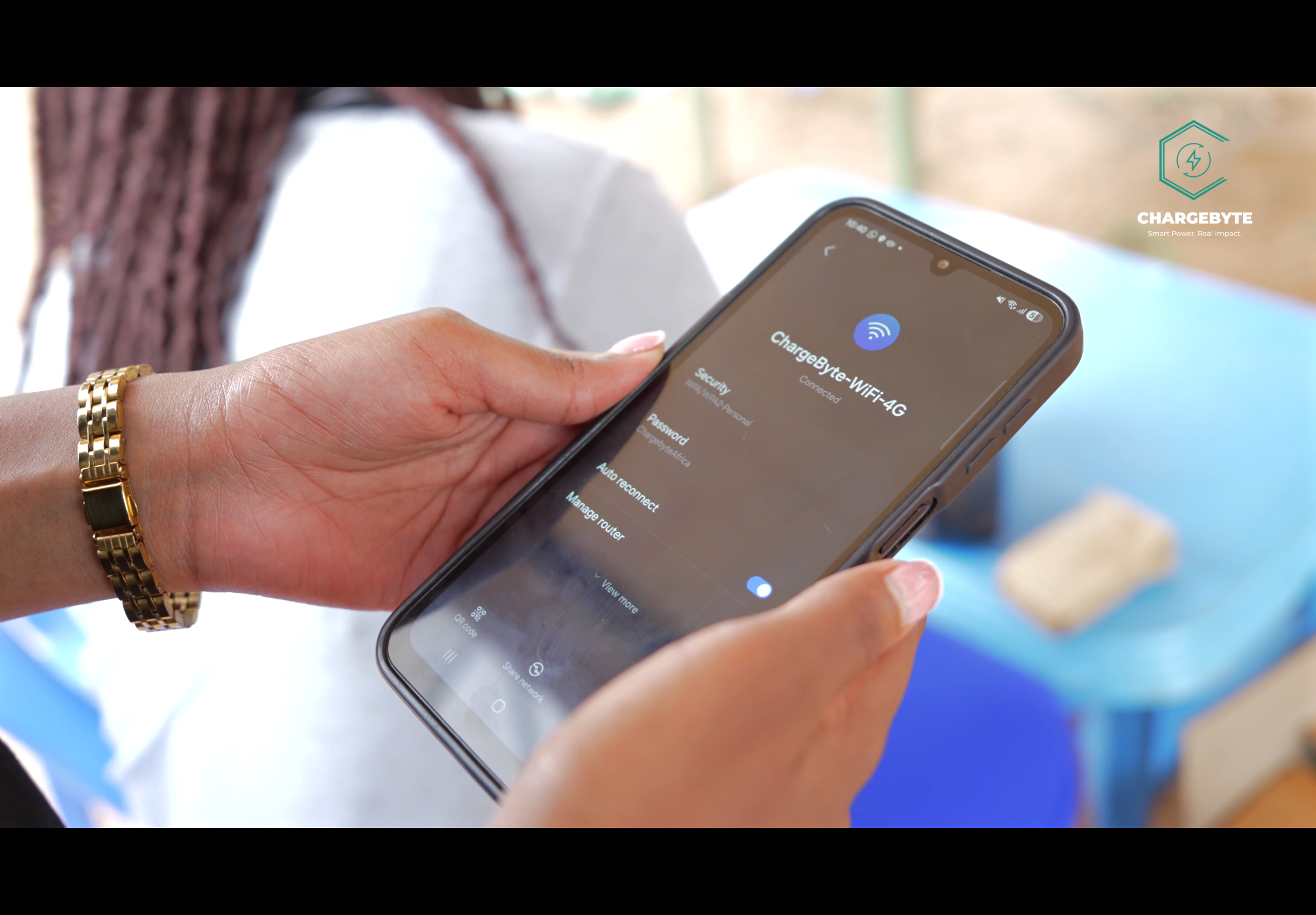
Photo Credit: Chargebyte
Hello World
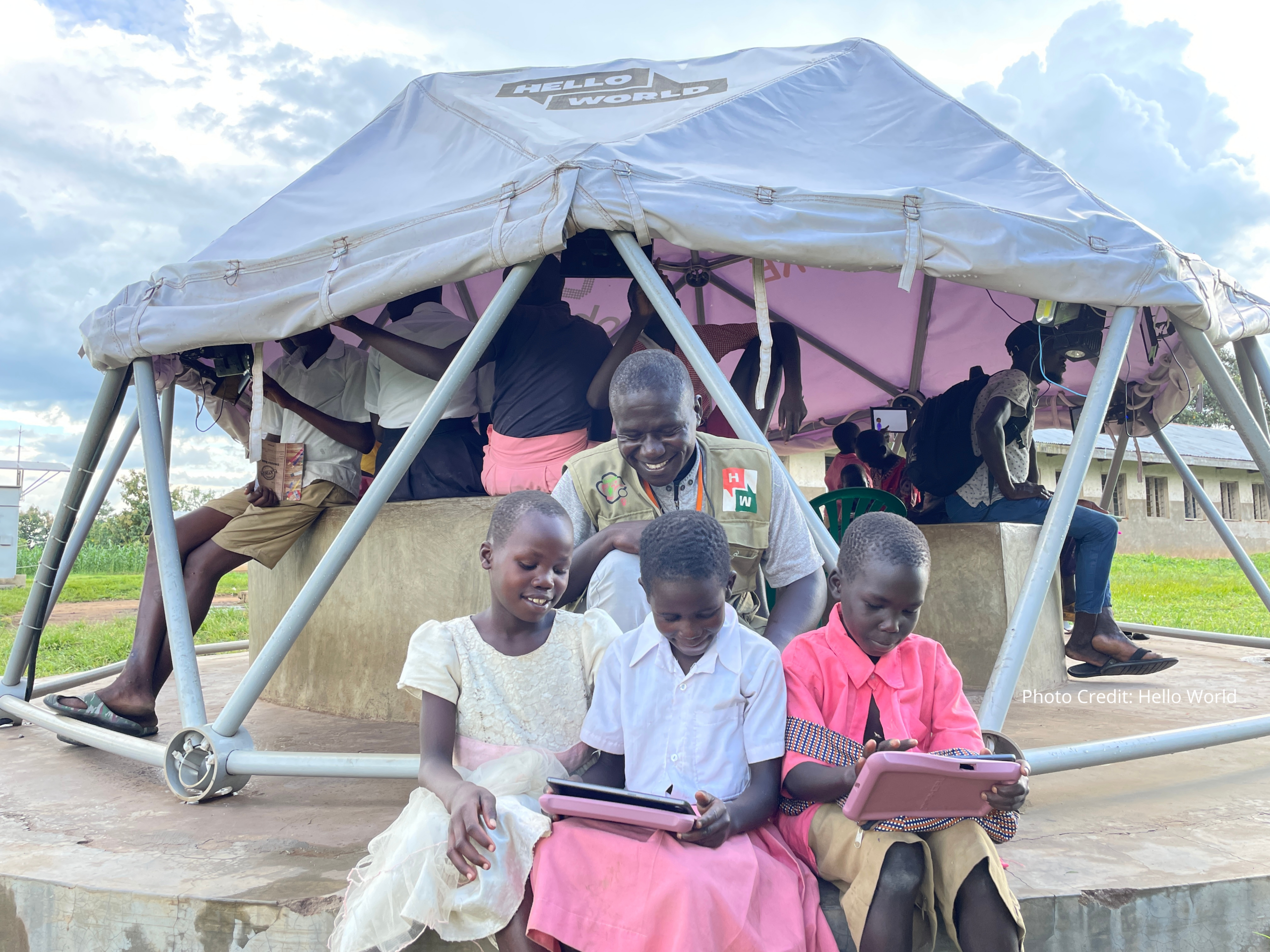
Hello World, a 14-year-old non-profit organization, works to close the digital divide through its “Hello Hubs,” modular, solar-powered internet hubs that are locally constructed and managed by the communities they serve. Each hub provides connectivity and durable tablets loaded with educational software.
The hubs use an open-source system compatible with available internet service providers.
Each offers an internet speed of 20 Mbps connectivity per site with an energy capacity of between 1.2kW and 3kW (1.5kW for school deployments). Battery reserves also charge lanterns and phones, and power schools, health centres and community facilities.
“Our approach aligns with the goal of the International Telecommunication Union (ITU) on meaningful connectivity for schools, ensuring that internet access is usable and impactful rather than merely available,” explains Mugerwa, the group’s director of technology and engineering.
Hello World has deployed 115 Hello Hubs, 85 of which are in Uganda, reaching more than 125,000 users. Over the next 18 months, there are plans to scale to more than 100 additional schools. Through the Giga Accelerator, the organization has developed an open-source guidebook to enable other organizations to replicate its model.
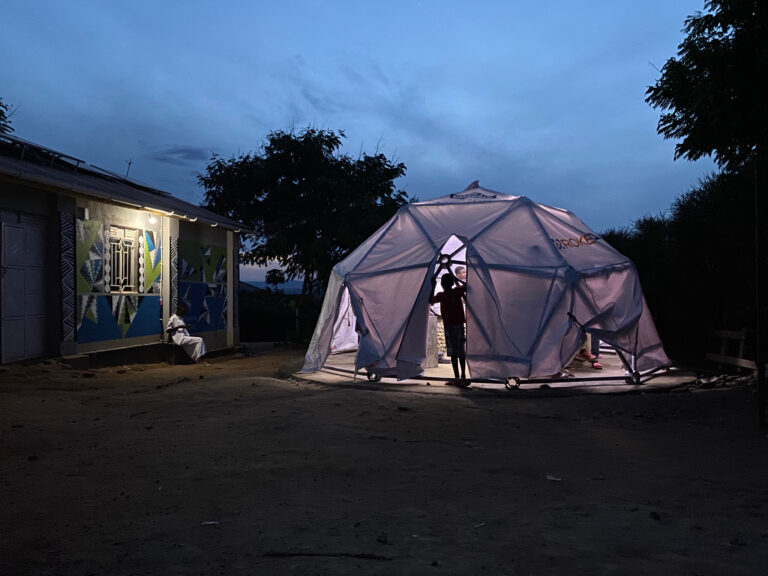
Photo Credit: Gerry Manacsa, Hello World
Wekkitech
Kenya-based Wekkitech, founded in 2022, delivers reliable connectivity to last-mile communities through its SomoLink platform, which combines panels, battery storage, and networking equipment into a self-contained unit that is independent of the grid.
During daylight, the solar panel charges a battery that powers the local internet access point. The site receives backhaul via a 1 Gbps fiber link, which is then extended via fiber and point-to-point wireless to reach remote schools.
“Our hybrid backhaul model lets us reach schools that fiber alone could never justify economically,” said founder Brill Okoth.
SomoLink boosts speeds from an unusable 0.3 Mbps to 20-plus Mbps, backed by a 10 Gbps backbone and use of their own Autonomous System Number (ASN).
Wekkitech has connected 20 schools and plans to expand its fibre backbone from 30 km to 300 km while deploying more than 500 additional solar-powered WiFi units, with further expansion planned into Uganda, Tanzania, and South Sudan. The company is also adding charging services to meet a major need in off grid areas where people often travel long distances to charge their phones.
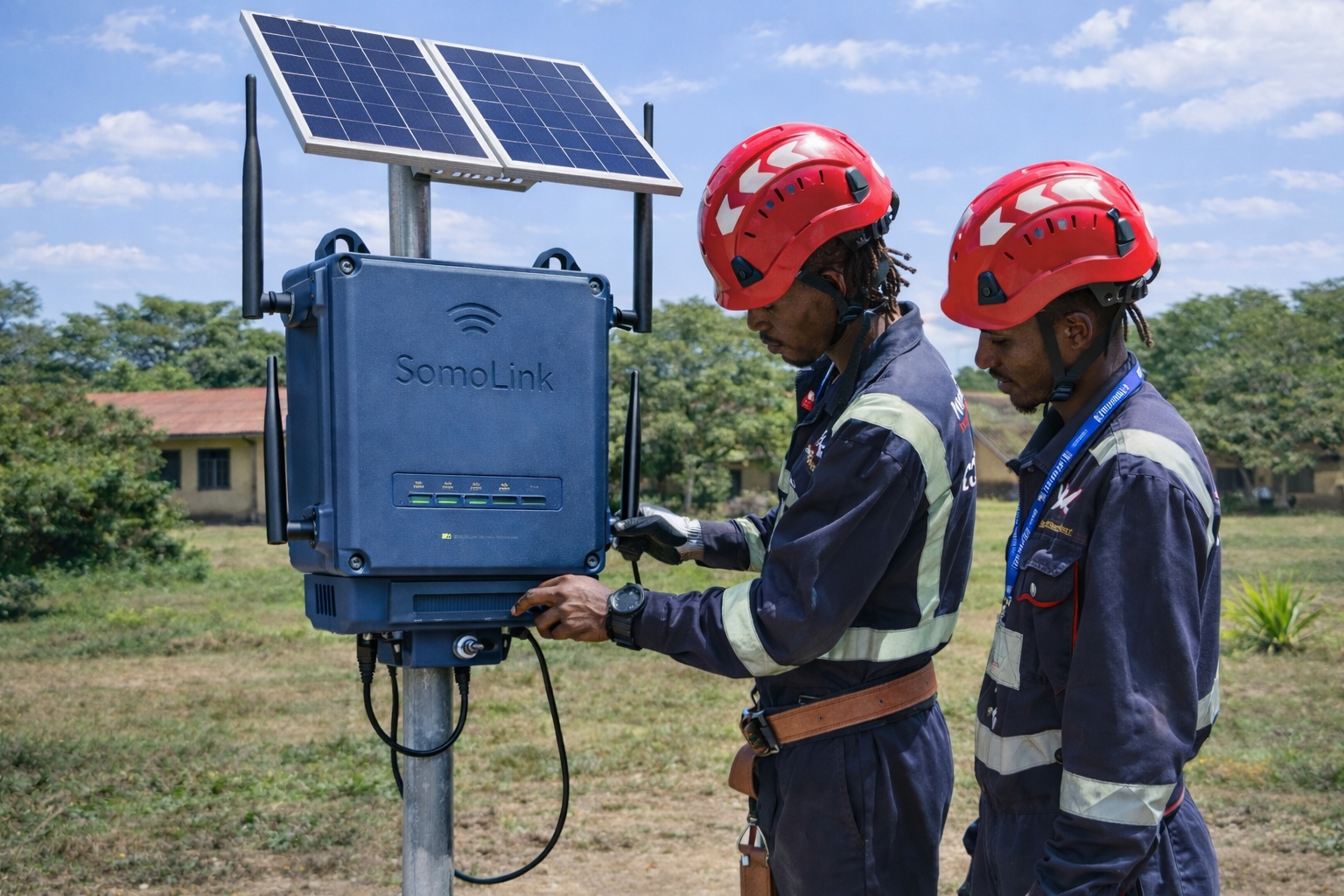
Photo Credit: Obed Mwaniki, Wekkitech
Peddle iLabs
Nigeria’s Peddle iLabs, established in 2021, creates mobile digital classrooms housed within a single transportable unit. A compact solar array with battery storage powers connectivity equipment, learning servers and devices, ensuring reliable operation even in schools without grid electricity.
Each classroom includes 50 solar-powered educational tablets supported by an AI platform that delivers gamified lessons in more than 100 languages. A mesh-network design delivers roughly 50–200+ Mbps depending on backhaul quality, while local learning servers reduce bandwidth demand and guarantee access to educational content within the classroom.
To maintain reliability in remote areas, the system combines online and offline content delivery, with local content servers hosting hosting educational resources when internet performance drops.
“This also reduces operational costs over time and enables schools in remote areas to participate in the digital education ecosystem,” said Joseph Orya, the company’s founder.
In communities such as internally displaced persons and refugee camps, the system is extended to provide small-scale charging services. To date, Peddle iLabs has reached over 25,000 children across refugee camps in Nigeria.
Peddle iLabs is currently establishing a local fabrication hub equipped with automated tools, 3D printers, and welding equipment to support assembly and maintenance. Its expansion plans include training teachers and connectivity champions in digital learning tools and device maintenance.
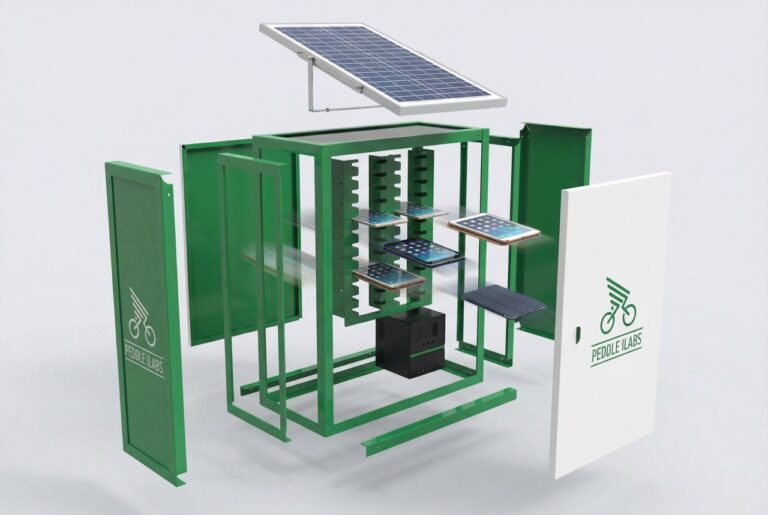
Photo Credit: Peddle iLabs
Solar’s role
Solar power is not a universal fix for the challenges of school connectivity and cannot replace the broader investment in telecom infrastructure needed to close the digital divide. But in rural and remote areas, it is enabling internet access in classrooms that would otherwise remain offline. As these four off-grid and hybrid solutions show, progress is incremental — school by school, community by community — using technologies adapted to local conditions to bring connectivity to the places where it is needed most.