
In today’s digital era, the education sector faces both remarkable opportunities and significant challenges. Millions of schools still lack reliable internet access, limiting progress toward inclusive, equitable and high-quality education for all. Closing this gap requires more than just connectivity, it demands a comprehensive approach to building digital public infrastructure (DPI) that can strengthen education systems and transform learning for the future.
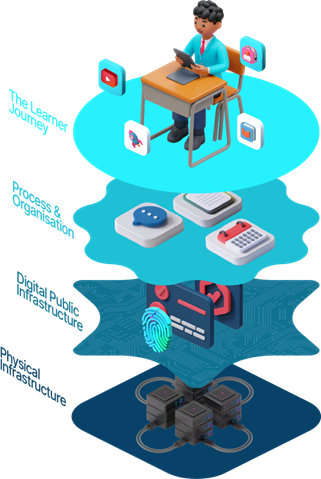
DPI provides a framework for designing interoperable and secure digital systems that support education service delivery. Rather than focusing solely on individual platforms or tools, a DPI approach strengthens the shared digital building blocks – such as identity, registries, data exchange and credentials – that enable systems to work together effectively.
Building the Case for Digital Public Infrastructure in Education, developed under Giga, explores how interoperable and scalable DPI can serve as the backbone for delivering accessible and equitable digital learning opportunities. The paper provides a structured analysis of how foundational digital systems can strengthen education architecture, foster innovation and contribute to the achievement of Sustainable Development Goal 4 (SDG4).
The paper examines existing solutions and strategic frameworks and proposes practical approaches for building resilient, learner-centred digital ecosystems.
By prioritizing interoperability and open standards, DPI enables collaboration across ministries, educators, technology providers and communities, helping countries scale digital transformation efforts in ways that are aligned with national priorities and local needs.
DPI provides a framework for designing interoperable and secure digital systems that support education service delivery. Rather than focusing solely on individual platforms or tools, a DPI approach strengthens the shared digital building blocks – such as identity, registries, data exchange and credentials – that enable systems to work together effectively.
Building the Case for Digital Public Infrastructure in Education, developed under Giga, explores how interoperable and scalable DPI can serve as the backbone for delivering accessible and equitable digital learning opportunities. The paper provides a structured analysis of how foundational digital systems can strengthen education architecture, foster innovation and contribute to the achievement of Sustainable Development Goal 4 (SDG4).
The paper examines existing solutions and strategic frameworks and proposes practical approaches for building resilient, learner-centred digital ecosystems.
By prioritizing interoperability and open standards, DPI enables collaboration across ministries, educators, technology providers and communities, helping countries scale digital transformation efforts in ways that are aligned with national priorities and local needs.
Why DPI Matters for Connected Schools
As more schools come online, the focus shifts from access to integration. Without interoperable digital foundations, connected schools may rely on fragmented systems that limit scalability and long-term sustainability.
A DPI approach helps countries:
A DPI approach helps countries:
- Strengthen coherence across digital education systems
- Reduce fragmentation and duplication
- Support trusted recognition of learning
- Embed safeguards for privacy and security
- Enable innovation within a stable public architecture
By combining connectivity with strong digital foundations, education systems can evolve in a secure, scalable and sustainable way.
Let’s build a connected future together