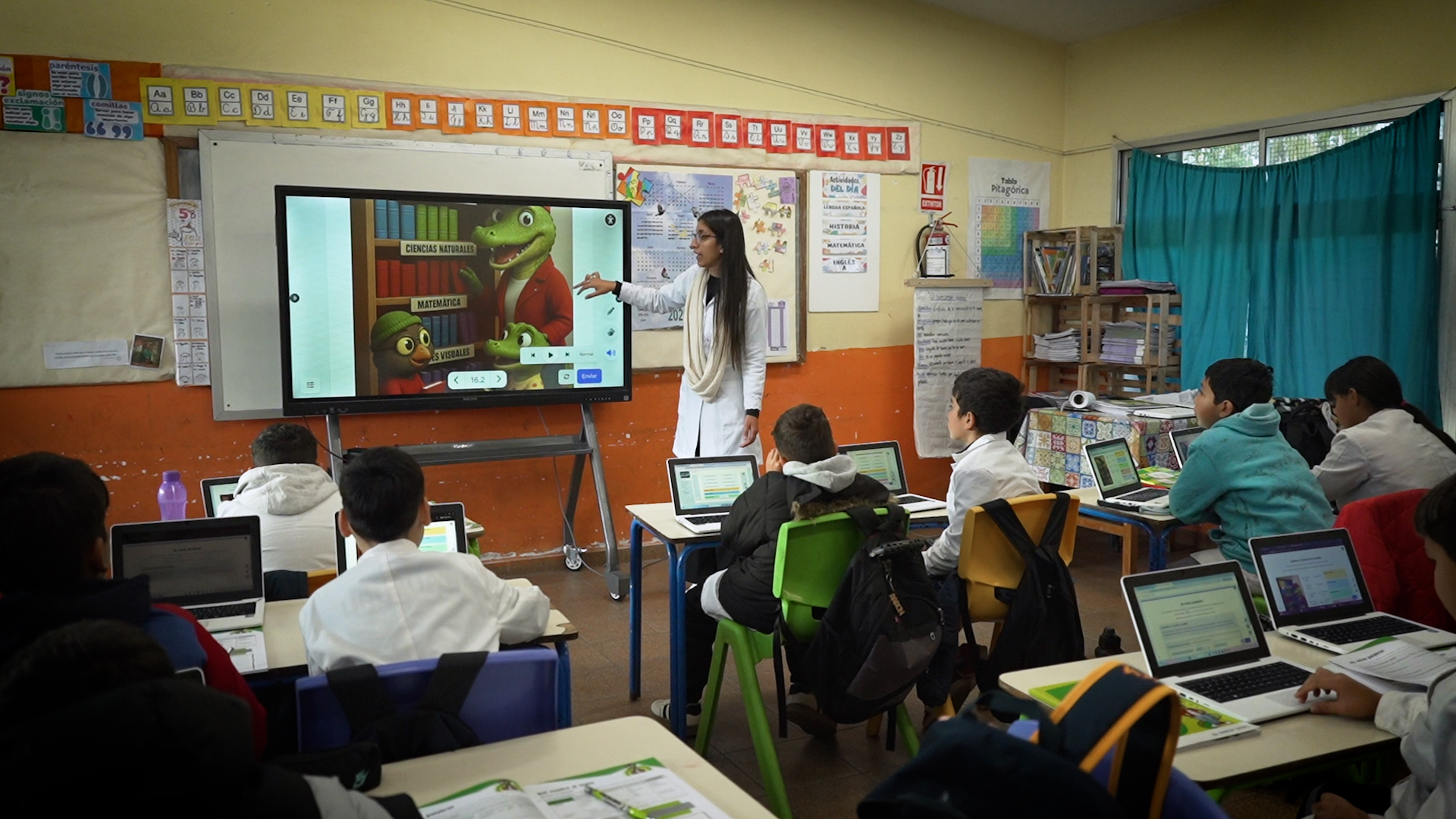
Ceibal, Uruguay’s national digital education and innovation agency, has been a global EdTech pioneer since its 2007 launch as Plan Ceibal—the world’s first initiative to provide every public primary school student with a laptop and free internet access. What began as a bold push to close the digital divide has evolved into a national platform integrating connectivity, devices, digital content, teacher training and data-driven learning.
Today, Ceibal is an internationally recognized model for scalable digital transformation, expanding access and advancing more inclusive, equitable education—an approach now carried into its Accessible and Inclusive initiative.
In this interview, Julia Eulén, coordinator of Ceibal Accessible and Inclusive, explains how the programme works.
When did this program begin, and how would you describe its impact on these students’ lives?
Ceibal has been committed to a line of work aimed at reducing barriers to learning through various projects. Specifically, the Ceibal Accessible and Inclusive initiative began in 2024, focused on reducing barriers and expanding learning opportunities for students with disabilities. This work includes training teachers in inclusive education, incorporating assistive technologies in the classroom, and conducting assessments to identify which technological tools can facilitate each student’s participation. The approach is not limited to providing devices; it also involves supporting teachers and families to ensure the effective use of technology.
The impact is primarily reflected in greater participation and autonomy. When a student has access to a device configured to their needs—for example, with a screen reader, an enlarged keyboard, or an eye tracker—barriers to communication, accessing content, and producing their own work are reduced, creating better conditions for learning and a more inclusive educational experience.
How was the curriculum developed? Did Ceibal develop it on its own, or did it adopt an existing framework and revise/improve it over time?
Ceibal does not develop curricula for inclusive education. Its role is to assist and support the implementation of the plans and guidelines established by the education system (the National Public Education Administration), by providing technological tools, training and specialized guidance. In this regard, the work is grounded in educational and rights policies related to the education of people with disabilities, with the goal of helping more students access, participate in and learn within the education system on an equal footing.
In your view, what is the right balance between digital learning technology and traditional approaches to supporting children with special needs?
At Ceibal, we believe that the balance lies in complementarity: technology does not replace teaching, but rather makes it more accessible, helping to overcome educational barriers. Traditional pedagogical approaches (such as teacher support, the use of concrete materials, visual aids, activity planning, routines and cooperative work) remain fundamental to learning.
Within this framework, technology acts as a facilitator: it enables access to content, reduces barriers, and facilitates different forms of participation—such as listening to or reading a text, writing or selecting answers, or demonstrating what has been learned in various ways.
In practice, the most effective approach is often a hybrid model, where technology is integrated with pedagogical intent and classroom support, and can even enable blended or distance learning formats when in-person access is difficult.
What techniques (data collection, etc.) do you use to tailor instruction?
In our case, we do not individualize instruction; that is the role of the teachers who work with the students on a daily basis. At Ceibal, we individualize the provision of devices through interviews and testing sessions with students, during which we work together with them and their teachers to determine which accessible device or technology can help them overcome barriers.
What unique benefits do digital tools offer children with special needs in terms of accessibility, personalization or learning outcomes?
The clearest benefits we identified are:
- Accessibility
So-called “assistive technologies” can be software or hardware and are designed to increase autonomy and access (screen readers, text-to-speech, speech recognition; trackballs, push buttons, enlarged keyboards, eye trackers, stands, among others). - True personalization
The same content can be presented through different channels (visual, auditory, reading aids, size/contrast, timing), and a student can respond in various ways (writing, selection, voice, aids). This reduces reliance on a single method of teaching and assessment. - Participation and communication
When access is ensured and supported, opportunities for communication and learning—and, above all, for presence and participation in the regular classroom—are expanded. - Educational continuity
In hybrid or distance learning formats, technology can sustain participation when there are mobility, health, or contextual barriers, provided there is inclusive instructional design.