
A new collaboration platform brings together network engineers, internet measurement experts, educators, and civil society organizations to build frameworks for actionable connectivity data for schools.
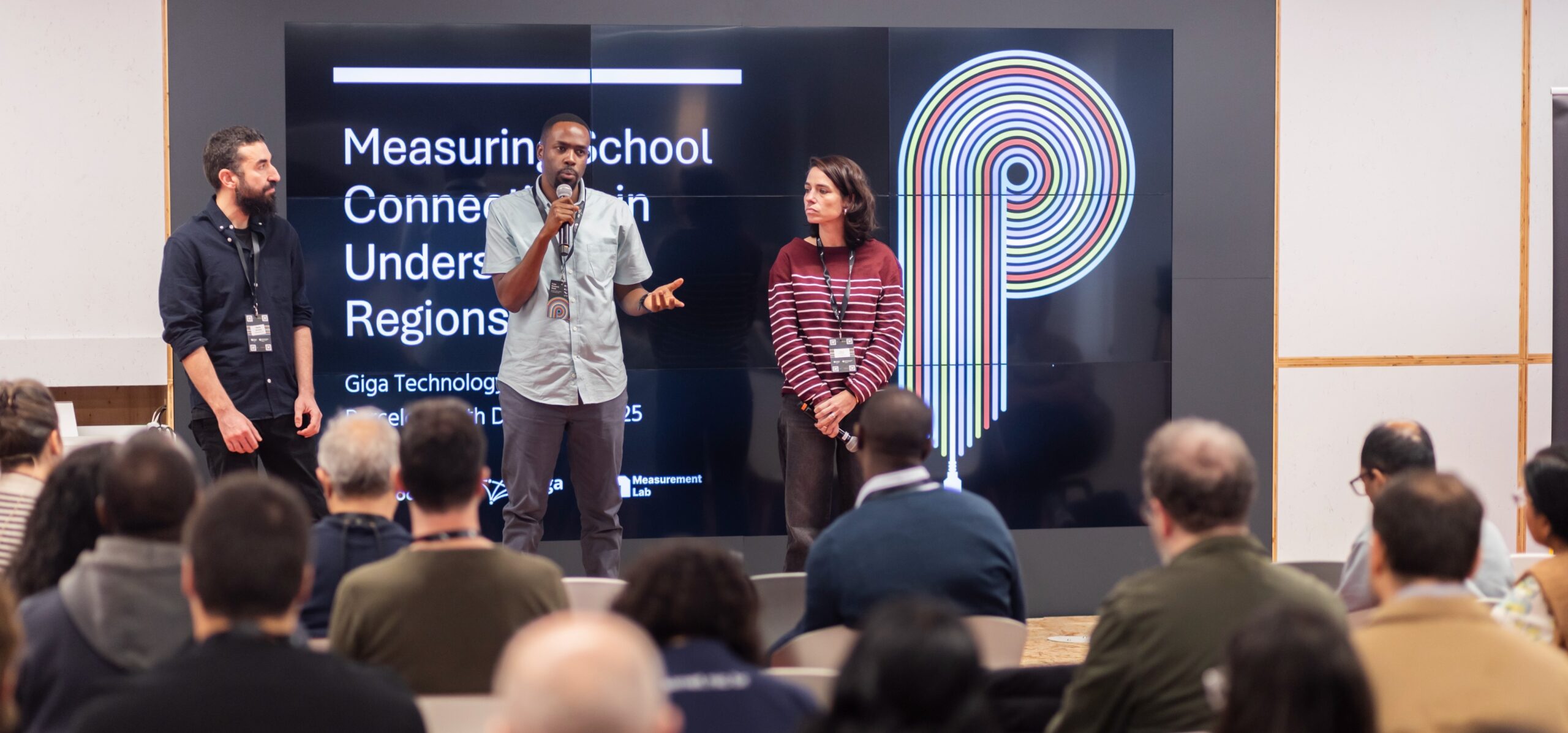
Giga, in partnership with Measurement Lab (M-Lab), launched a Community of Practice (CoP) dedicated to strengthening how connectivity is measured, interpreted, and acted upon. The online launch event, held on 11 March 2026, brought together 51 participants from across the globe – spanning Ghana, Spain, Sweden, Mongolia, South Africa, the United Kingdom, the United States, and beyond – to help shape the CoP’s first-year agenda.
A community connecting data to decisions
The new CoP is designed to close the gap between technical measurement capability and policy usability. Stewarded by Giga and M-Lab, the community brings together stakeholders working at the intersection of internet measurement and connectivity for public facilities to surface shared challenges in measuring school connectivity, and developing standards that are interpretable, reproducible, and usable for policy and decision-making.
From the community: Key themes for exploration
During the discussions, participants offered contributions on themes to explore. These include:
- Supporting Internet Service Providers (ISPs) through usage measurements: How can tools be used to show ISPs how connectivity is actually used by students, and is there a way to integrate this usage directly into measurement tools, including Giga Meter?
- Infrastructure-aware metrics: Developingconnectivity metrics that draw on middle-mile and last-mile network data to contextualize performance at the school level – including the proximity of Content Delivery Networks (CDNs) and regional connectivity of large providers.
- Equity within the local network: Building a graph of the local connectivity environment to infer connection quality and quantify equity and usability at the facility level beyond the school’s external connection alone.
- Contextual and regulatory differences: Exploring whether the measurement framework can adapt to different country contexts, particularly where content restrictions affect access to information and, by extension, the right to education.
Basis discussions the research agenda is being finalized. It can be accessed here on request.
Why measurement matters
Connectivity is foundational infrastructure for education to ensure digital inclusion and equal opportunities for all. Yet a persistent gap remains between what is technically measurable and what is practically usable by the decision-makers Giga works with – particularly Ministries of Education and Ministries of ICT/Regulators – who navigate complex, resource-constrained environments.
Giga’s work across countries has surfaced a consistent challenge: the absence of consistent, comparable, and actionable connectivity data. A school in West Africa may technically have a connection, but it is capped at 1GB per month, used solely for logging grades into a government system. A school in Central Asia may have strong service on paper, but measurements reveal throughput oscillating between just 2 to 8 Mbps for over 300 students. In Southern Africa, an active measurement tool pings a server 1,200 kilometres away, across two national borders, raising fundamental questions about what that measurement actually reflects.
These cases represent the real-world context in which Giga operates, and they underscore why a single bandwidth threshold – such as guidance requiring 10 Mbps for a school – is insufficient without the contextual framework to back it up.
Giga’s role: Bridging data and policy
Giga uniquely bridges technical rigor and policy influence. As a UNICEF-ITU partnership, Giga has the country relationships, the expertise in telecommunication/ICTs, regulatory frameworks and capacity development, and the credibility to translate measurement insights into government action.
The initiative already maintains a live global map of school connectivity and has been collaborating with M-Lab for several years. Central to that collaboration is Giga Meter, Giga’s open-source monitoring tool that collects continuous telemetry from devices installed directly in schools.
This continuous measurement approach is core to Giga’s ambition: generating data that is not just technically accurate, but actionable for government officials making decisions about procurement, investment, and accountability.
M-Lab provides the world’s largest open-source internet performance platform. Its dataset – now exceeding six billion test results – is publicly accessible and used for research and governance frameworks. For Giga, M-Lab’s infrastructure provides the measurement backbone, while Giga’s ground-level deployment and country-level relationships provide the reach and opportunities for scale.
Advancing applied measurement for school connectivity
The community’s initial research agenda spans four tracks: improving measurement tools (including application-layer measurements for video and web browsing), characterizing facility-level connectivity, developing an Internet Quality Barometer (IQB) for education, and extracting new insights from existing measurement data.
Working groups and regular convenings are planned throughout the first year, with an emphasis on producing technical outputs that further the field of school connectivity measurement and inform decisions to improve outcomes for students and teachers.
Interested in learning more? Sign up to receive updates on future activities at the following link.